Lukas Kuhn
I'm a research scientist at the MLO Lab led by Prof. Dr. Florian Buettner in Frankfurt working on world models.

Research
I believe temporal prediction is a powerful learning signal for building rich, general-purpose representations of the world, and that JEPAs are a promising framework for learning such representations efficiently and at scale. My research focuses on developing novel JEPA architectures and training objectives, investigating their properties and capabilities, and applying them to a range of domains including vision, language, and robotics. Some papers are highlighted.
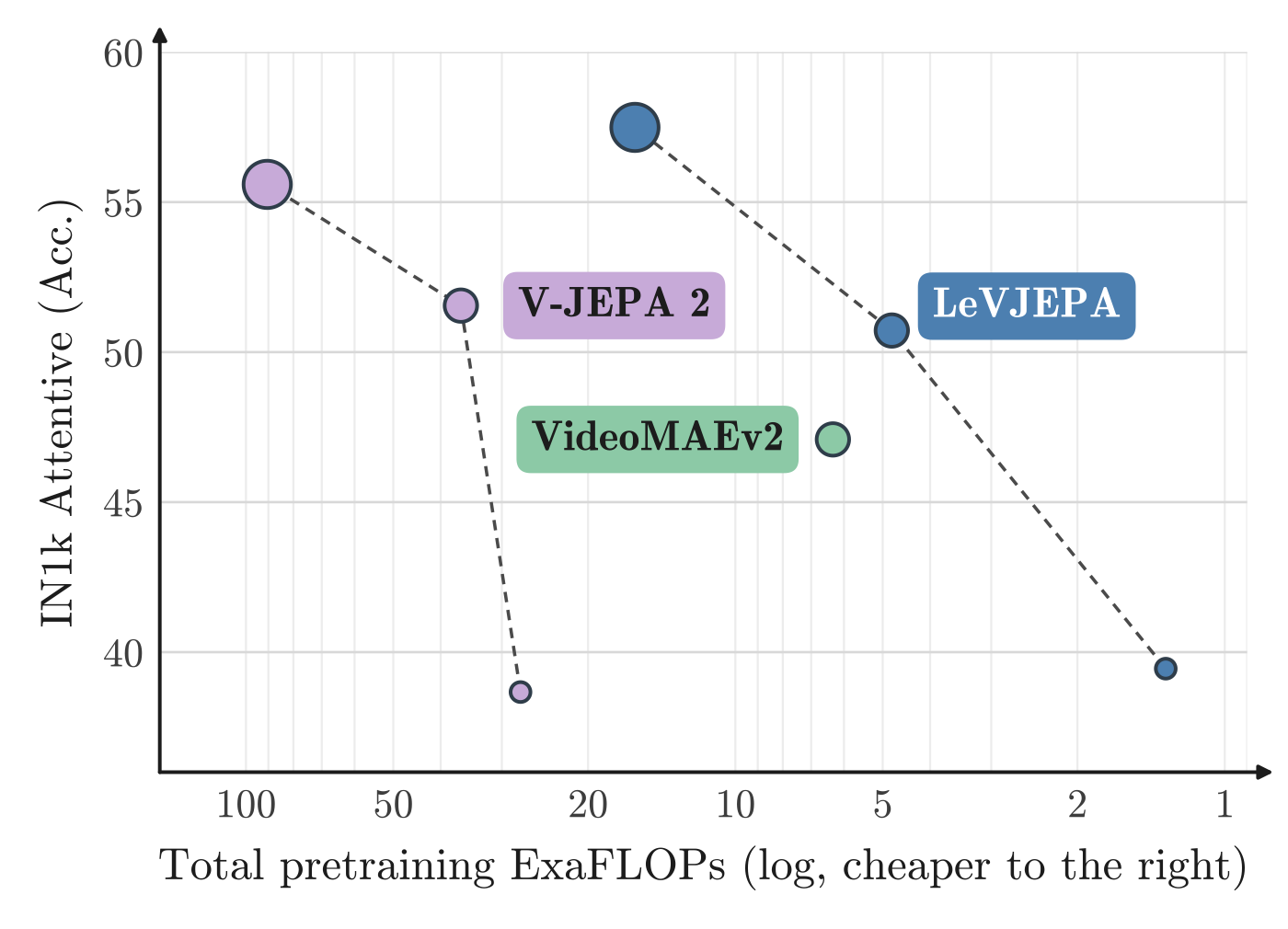
Lukas Kuhn, Lucas Maes, Giuseppe Serra, Quentin Le Lidec, Yann LeCun, Randall Balestriero, Florian Buettner
arXiv, 2026
project page / arXiv / code / checkpoints
LeVJEPA is the first video encoder trained under LeJEPA's collapse-free objective, dropping the EMA target encoder, stop-gradient, and predictor entirely. A single encoder and projector trained with an invariance loss plus SIGReg matches or exceeds V-JEPA 2 across ViT-S/B/L at 5.6-20.8x less pretraining compute, and admits block-causal attention at no cost in accuracy.
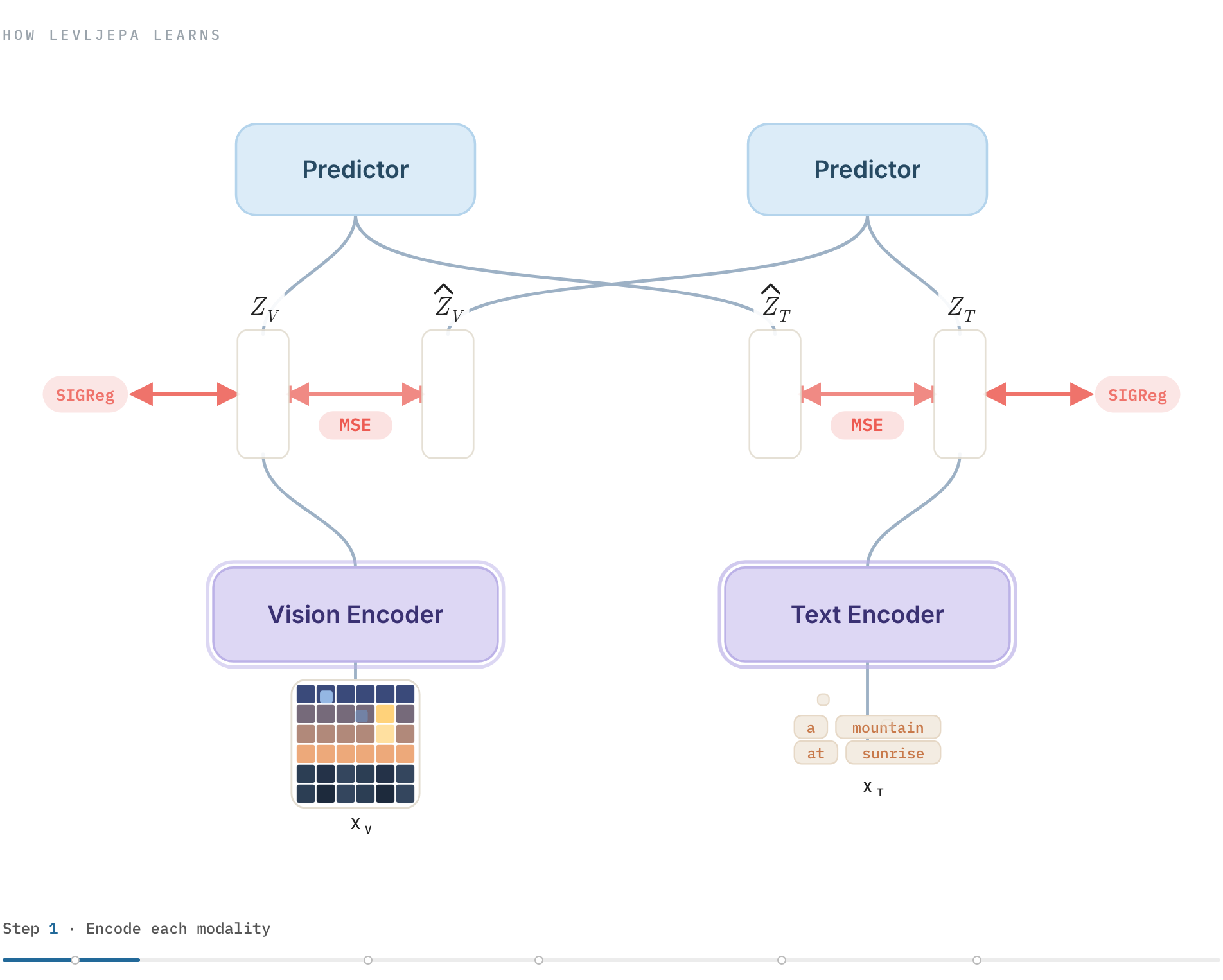
Lukas Kuhn, Giuseppe Serra, Randall Balestriero, Florian Buettner
arXiv, 2026
project page / arXiv
We introduce LeVLJEPA, an end-to-end non-contrastive vision-language pretraining method that learns through cross-modal prediction with stop-gradient targets and per-modality distributional regularization. LeVLJEPA produces strong dense semantic features for frozen VLM backbones and semantic segmentation, without negatives, temperature scaling, momentum encoders, or teacher-student schedules.
Lukas Kuhn, Giuseppe Serra, Florian Buettner
CVPR 2026 MULA Workshop, 2026
project page / arXiv
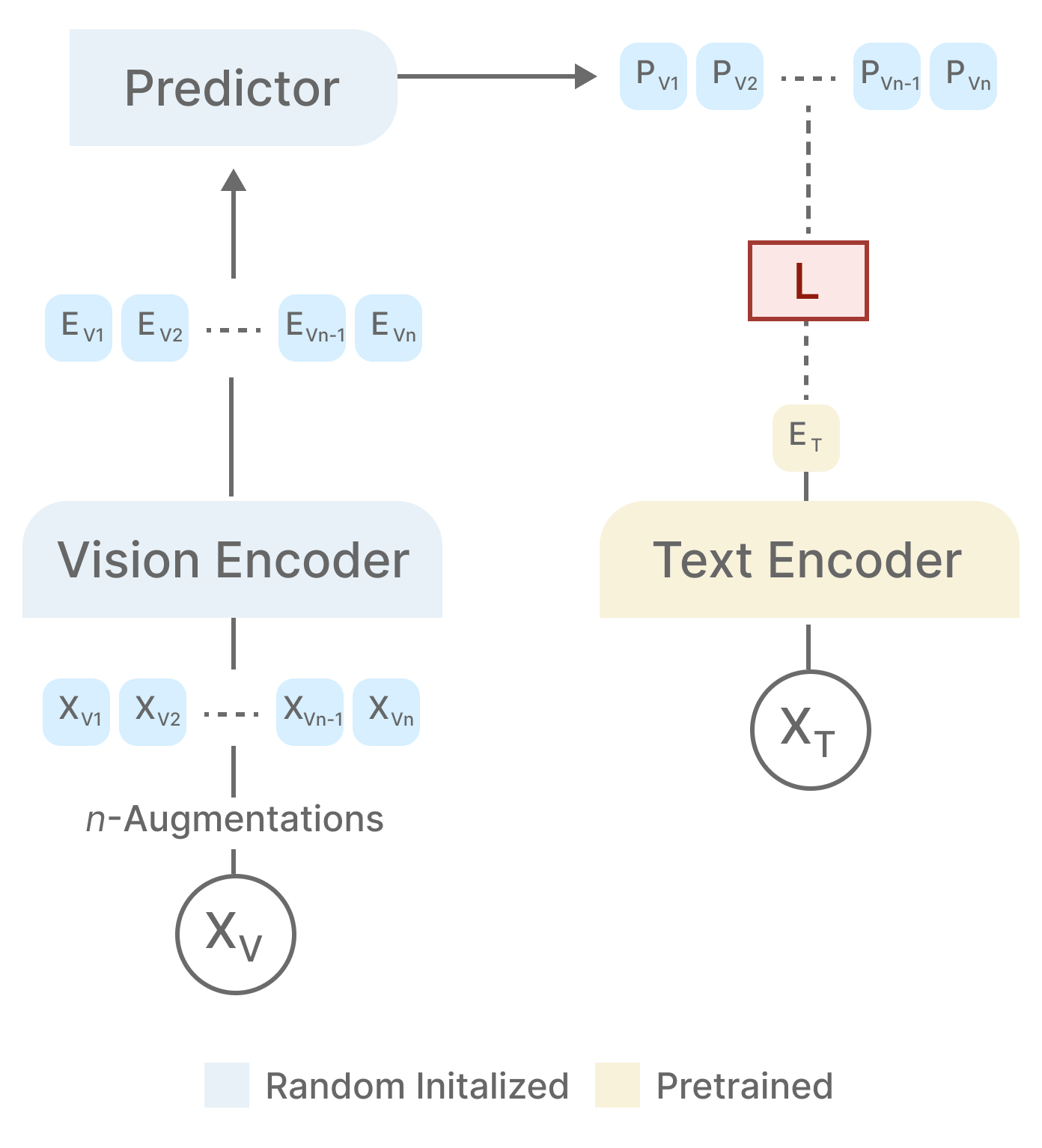
We introduce NOVA, a non-contrastive vision-language alignment framework based on joint
embedding prediction with distributional regularization. NOVA aligns visual representations
to a frozen text encoder by predicting text embeddings from augmented image views, while
enforcing an isotropic Gaussian structure via SIGReg.
Alexander Koeber, Lukas Kuhn, Ingo Thon, Florian Buettner
CVPR, 2026
arXiv
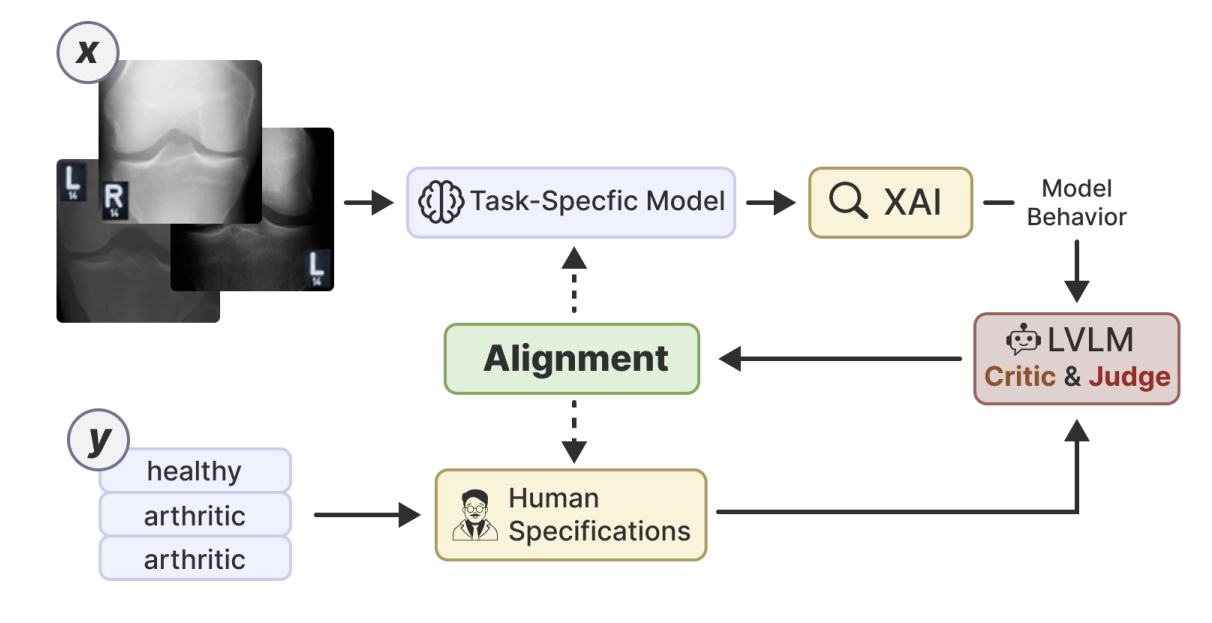
Small vision models in high-stakes domains often learn spurious correlations that don't align with human expertise. LVLM-VA uses large vision-language models as a bridge between domain experts and task-specific models, translating human knowledge into actionable feedback that reduces reliance on spurious features without requiring fine-grained annotations.
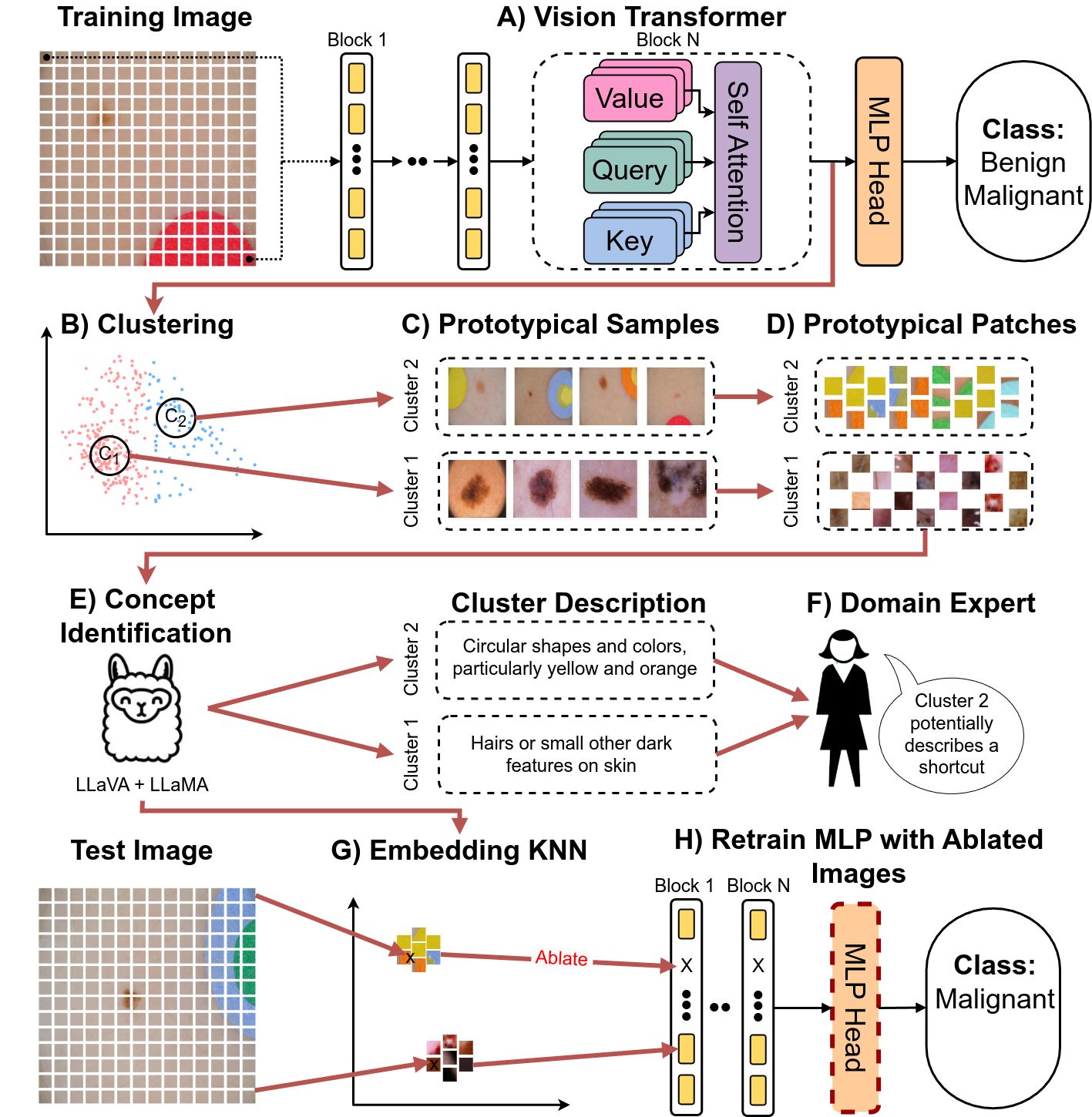
Lukas Kuhn, Sari Sadiya, Joerg Schlotterer, Florian Buettner, Christin Seifert, Gemma Roig
ICCV, 2025
project page / arXiv
By leveraging MLLMs and the representational structure of the Transformer architecture we detect and mitigate shortcuts completely unsupervised.
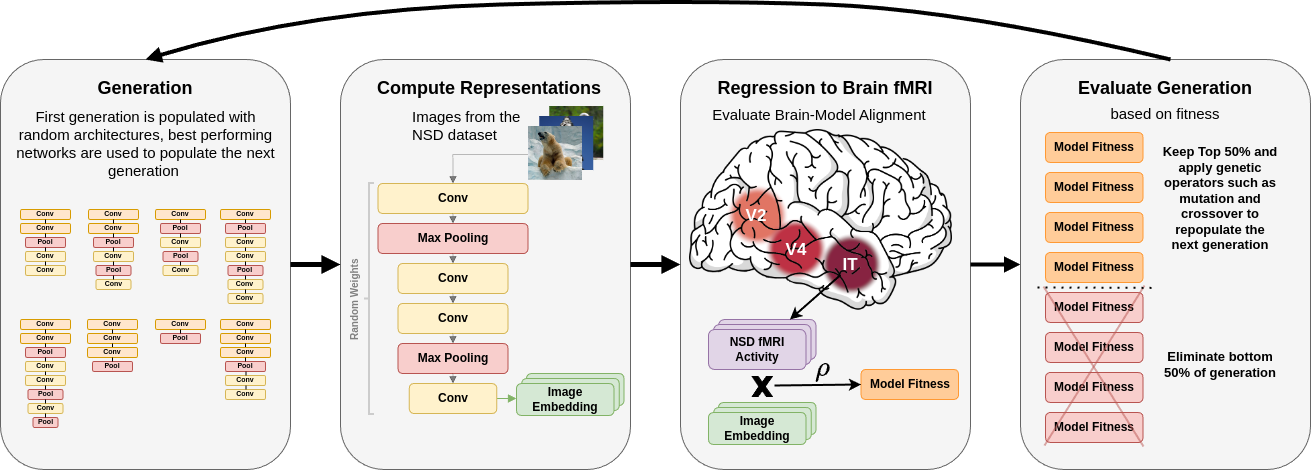
Lukas Kuhn, Sari Sadiya, Gemma Roig
ICLR ReAlign, 2025
arXiv
Optimizing convolutional network architectures for brain-alignment via evolutionary neural architecture search results in models with clear representational hierarchies, surpassing even pretrained classification models on brain-alignment scores.
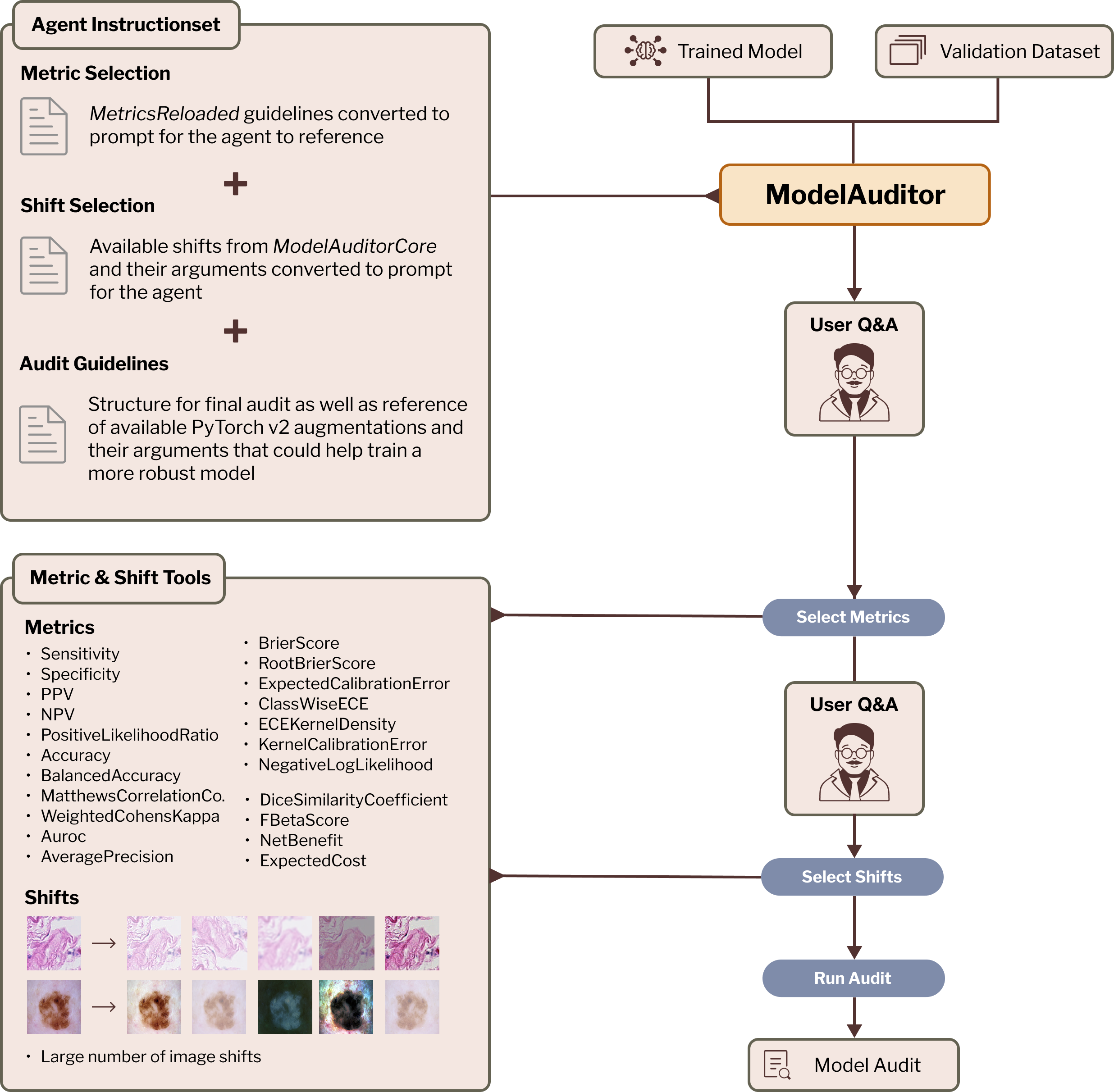
Lukas Kuhn, Florian Buettner
MICCAI MedAgent, 2025
arXiv
Multi-agent architecture that generates interpretable reports explaining how much computer vision model performance likely degrades during deployment, discussing specific failure modes and identifying root causes and mitigation strategies.
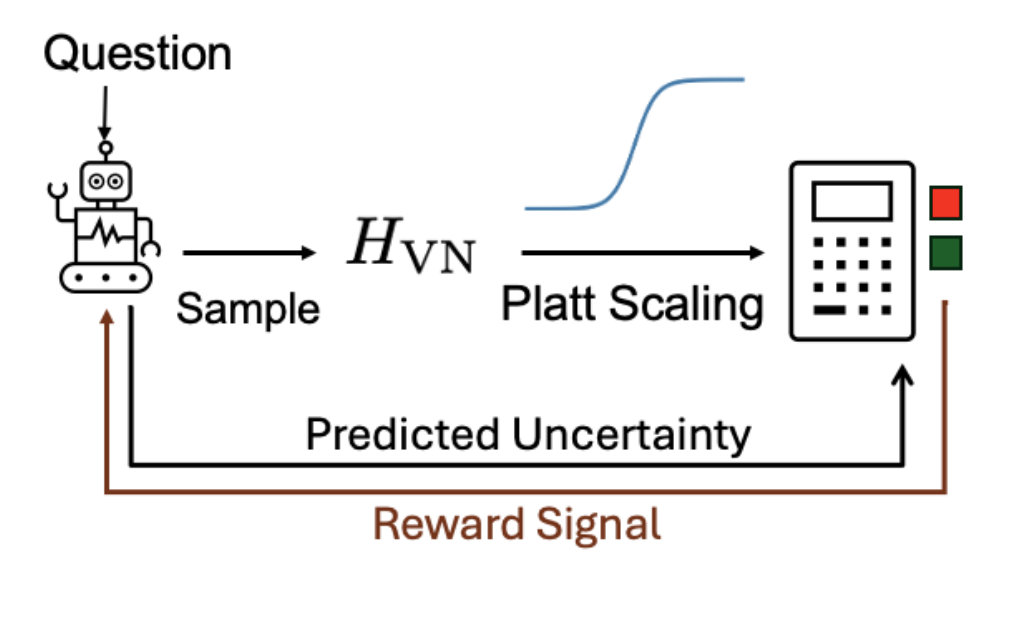
From Entropy to Calibrated Uncertainty: Training Language Models to Reason About Uncertainty
Azza Jenane, Nassim Walha, Lukas Kuhn, Florian Buettner
AISTATS 2026 Calibration for Modern AI Workshop, 2026
arXiv
We introduce a pipeline for post-training language models to efficiently estimate calibrated uncertainty in their responses, combining entropy-based scoring, calibration, and reinforcement learning to improve interpretability and reliability.
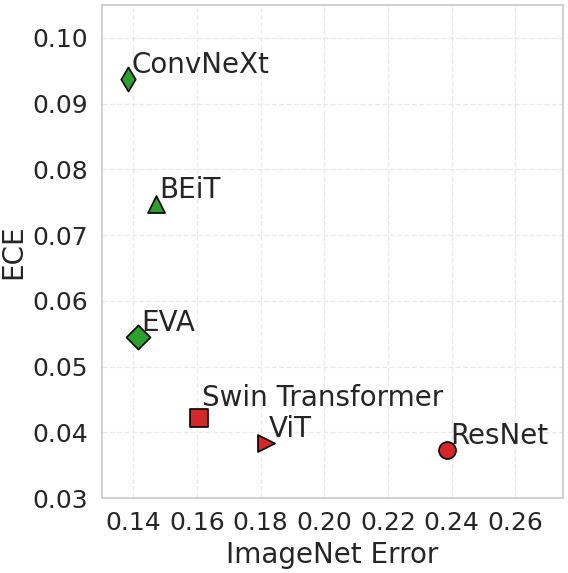
Achim Heckler, Lukas Kuhn, Florian Buettner
arXiv, 2025
arXiv
Empirical analysis of vision foundation models showing they tend to be underconfident on in-distribution predictions, resulting in higher calibration errors, while demonstrating improved calibration under distribution shifts.
Design after Jon Barron